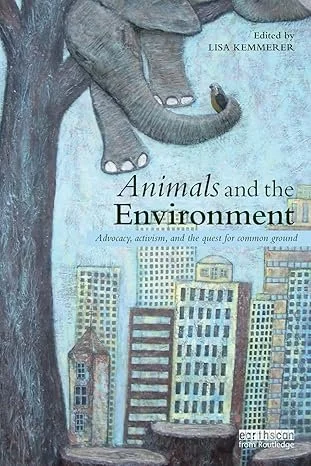
Animals and the Environment
Dr. lisa kemmerer
ISBN: 978-1138825888
Publisher: Routledge, 2015
Overview
Drawing on a wide range of issues and disciplines, this diverse collection of engaging essays highlights common ground between earth and animal activists. The first book on the subject, Animals and the Environment explores shared philosophical groundings, exposes common cause, and raises a host of pressing and intriguing questions and concerns that lie at the intersection of environmental and animal ethics. This collection features teachers, grassroots activists, and international lobbyists whose expertise lies in mathematics, sociology, physics, ecology, psychology, Asian philosophy, ecofeminism, ethics, and biology. They hale from Malaysia, Greece, Canada, The United States, Norway, and Uganda, including the voices of a Chicana Indigenae, a Native American, and an Indian-American. Authors explore diverse and intriguing real-life concerns such as the Southeast Asian palm industry, trapping and wildlife management, ethics and zoos, bears and habitat loss, nature films and ecofeminism, elephants and rural human communities. On topics such as habitat destruction, animal agriculture, and politics, Animals and the Environment explores overlapping interests through contemporary examples: Ways of valuing grizzly bears in British Columbia, the mathematics of diet and environmental footprint in Greece, threats stemming from palm oil plantations in Southeast Asia, and the struggle for land between elephants and villagers in rural India. And through it all, narratives in Animals and the Environment demonstrate the common sense, viability—and urgent importance—of establishing a united front on behalf of the environment and animals against the powers of big government and big industry.
Book Quotes
“Despite severe ecological consequences, environmentalists tend to be unaccountably silent on the topic of dietary choice.”
— Animals and the Environment: Advocacy, Activism, and the Quest for Common Ground
“In a world with so many desperate problems facing nonhuman animals and the environment, and also because systems of oppression link animal exploitation and environmental degradation, it is ineffective to ask, “Who is right?” and “Where can we draw lines?” We would be much more successful if we would ask, “How can we work together?”
— Animals and the Environment: Advocacy, Activism, and the Quest for Common Ground
“On what legitimate grounds would an informed, sincere environmentalist align with hunter interests when hunter interests damage ecosystems?
— Animals and the Environment: Advocacy, Activism, and the Quest for Common Ground
[Westerners] tend to view humanity as separate and distinct from chickens and lobsters and trees, as above and rightly in control of forests and waterways and flocks of seagulls. This worldview, which appears self-serving, is ultimately self-destructive.
— Animals and the Environment: Advocacy, Activism, and the Quest for Common Ground