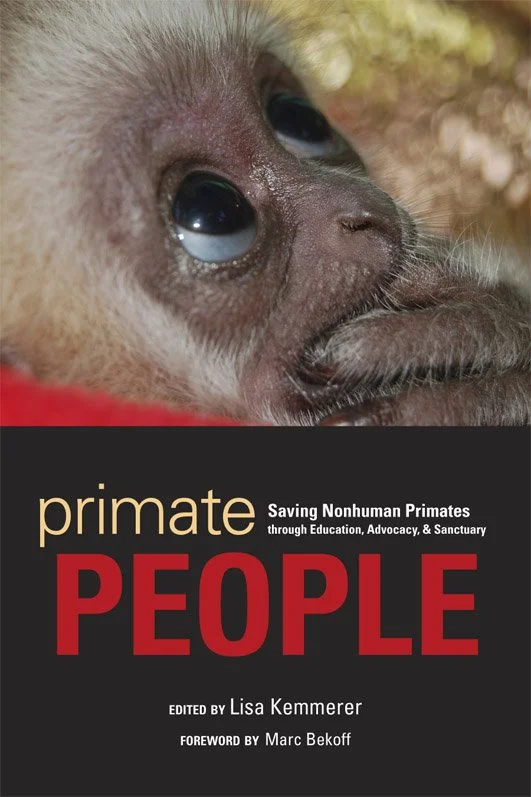
Primate People: Saving Nonhuman Primates through Education, Advocacy, & Sanctuary
Dr. lisa kemmerer
ISBN: 978-1607811534
Publisher: University of Utah, 2012
Overview
Primate People features undercover agents, scholars, and researchers, sanctuary founders and grassroots lobbyists fighting vivisection or seeking to protect vital habitat. Authors who work in Malaysia, Spain, Thailand, England, Wales, South Africa, Colombia, Denmark, the United States, and Indonesia writes of their work with baboons, woolly monkeys, capuchins, gibbons, gorillas, macaques, owl monkeys, lemurs, lorises, De Brazza’s monkeys, chimpanzees, and spider monkeys. Seasoned scholars, adventuresome volunteers, and undercover investigators introduce readers to the antics and pleasures, idiosyncrasies, sufferings and fears of nonhuman primates: a baboon caught in a snare, a chimp reluctant to trust humanity, and number 16162—a timid macaque trapped at a primate research lab who loved to play with mirrors but was never given so much as a proper name. Authors explain how we—any one of us—usually out of ignorance and sometimes in unexpected ways, endanger and harm these vulnerable individuals. And explain how each of us can help. Primate People vividly depicts the many reasons why these sensitive and endearing primates are at risk, while also demonstrating the power and importance of individual initiative and organized activism to bring much-needed change. Primate People is full of tenderness, courage, and hope.
Book Quotes
“Collectively, we are not only ignorant of other primates, but chillingly indifferent”
— Primate People: Saving Nonhuman Primates through Education, Advocacy, and Sanctuary
“Nonhuman primates are many and wondrous, yet few and endangered. Everywhere they live they have been crowded out of diminishing forests, hunted for food or medicinal value, captured for the lucrative pet/tourist trade, and either kidnapped or bred for science. As a result, every primate species on the planet—aside from the human being—is either endangered or threatened.”
— Primate People: Saving Nonhuman Primates through Education, Advocacy, and Sanctuary
“Her boyfriend bought a baby capuchin, whom she named Samantha. He quickly grew tired of the little troublemaker, only to find that his girlfriend—when forced to choose between him and the difficult, diminutive capuchin—sent him packing.”
— Primate People: Saving Nonhuman Primates through Education, Advocacy, and Sanctuary
“All was not right with the little motherless macaques and baboons who clung desperately to surrogate mothers: PVC pipes covered with cloth in otherwise barren cages.”
— Primate People: Saving Nonhuman Primates through Education, Advocacy, and Sanctuary